Devon · TQ12
Thermal imaging survey in Newton Abbot
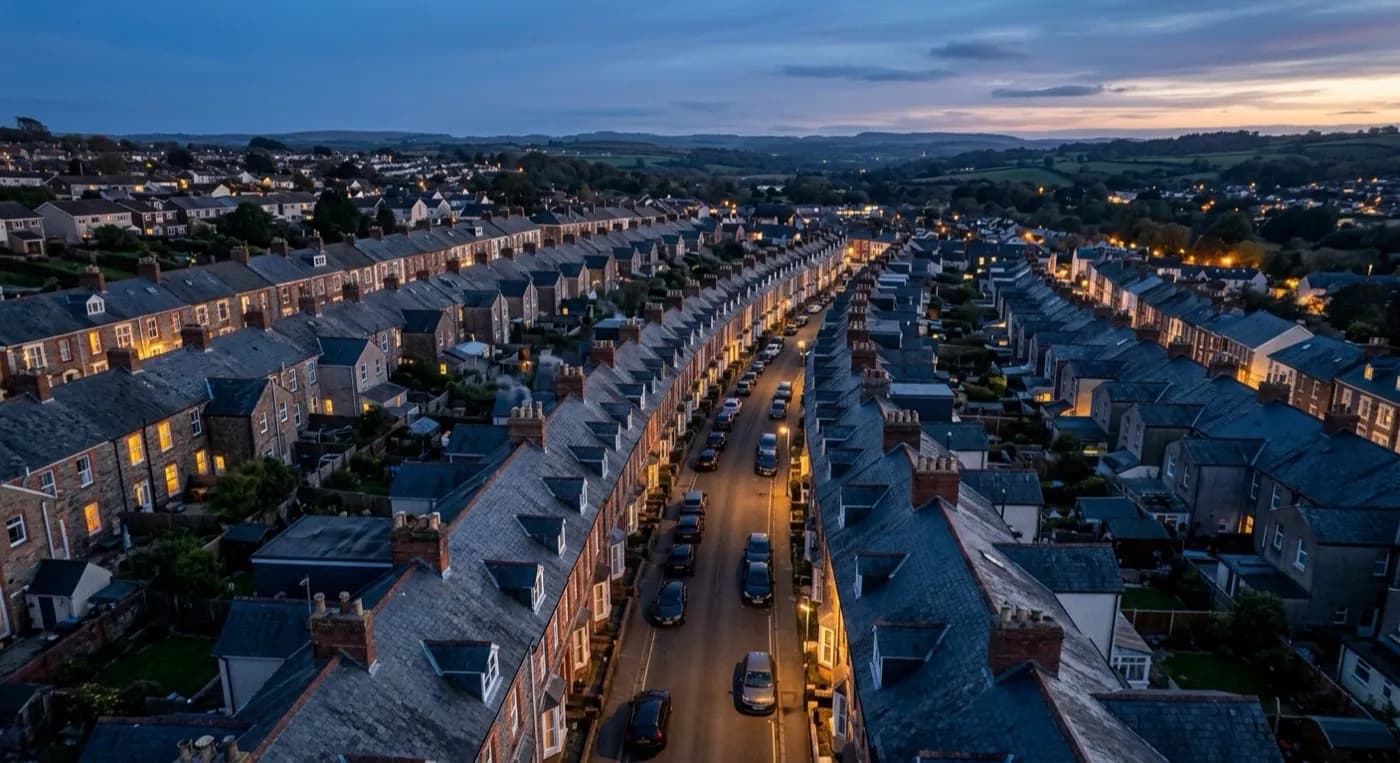
Thermal surveys in Newton Abbot, where large numbers of Victorian railway-era terraces sit beside extensive post-war estates on the damp, low-lying floodplain of the Teign.
A railway town built quickly, twice over
Newton Abbot grew fast around its railway works, and that shows in the housing: large numbers of Victorian terraces built in the same era and often the same repeated pattern, solid wall with the thinner detailing typical of quickly built worker housing rather than the grander stock found in some of the market towns further inland. Extensive post-war estates and substantial modern development at Houghton Barton and Wolborough grew the town again in the second half of the twentieth century, bringing the familiar cavity-era range of questions into a town whose older core is dominated by a single, fairly uniform construction type.
Because so much of the Victorian stock was built to one pattern in one period, a finding on one railway-era terrace here is often actually useful evidence for its immediate neighbours, in the same way a mill-terrace finding is at Tiverton.
Low, damp and less wind-exposed than the coast
The town sits on the flat floodplain where the Teign becomes tidal, ringed by hills, which makes it low-lying and damp with mist off the river a regular feature, rather than the direct wind exposure the coastal towns on this list contend with. Shaded, damp conditions hold moisture in a solid wall for longer between dry spells than a more open, breezier site, and that persistent low-level damp is a slower but still real drag on how well the Victorian terraces hold heat.
The estuary does still bring in easterlies during winter, which is a less common wind direction for this coverage area generally, and a thermal survey timed to avoid a spell of that easterly weather, rather than assuming the more usual south-westerly pattern, tends to give a cleaner reading here.
Flying a flat, damp floodplain town
A dawn flight after a cold, clear night works well given how consistently the floodplain holds its overnight chill, and mist is checked in the forecast the same way fog is watched at Honiton, since it affects visibility as much as temperature.
For the extensive post-war estates, coverage is straightforward given the wider streets, and a single visit often takes in several addresses for a landlord with property across more than one part of the town.
Streets near the former Great Western railway works carry the most concentrated run of Victorian terraces in the town, built for the same workforce in the same short period, while properties towards Stover Country Park on the edge of town are more likely to be post-war or modern, a different construction generation entirely despite being only a short drive from the terraces. Near Newton Abbot Racecourse, the housing is a mix of both eras side by side, and a survey there is planned by checking the specific property's construction rather than assuming either pattern from the area alone.
Behind the survey
What Newton Abbot clients are actually buying
CAA registered
Operator ID and Flyer ID held, plus the A2 Certificate of Competency. Every flight, including the early morning and after-dark ones this survey often needs, is planned to the rules that apply to the site.
Radiometric thermal camera
A DJI Mavic 2 Enterprise Advanced carrying a 640 by 512 radiometric sensor. Radiometric means every pixel is an actual temperature reading, not just a colour, which is what makes a genuine comparison across a roof or a wall possible.
100 megapixel visual pass
A DJI Mavic 4 Pro with a Hasselblad camera flies alongside the thermal camera on every job, so a warm or cool patch on the thermal image can be matched back to the actual roof feature or wall detail underneath it.
Insured with Coverdrone
Full commercial cover for the operation. Certificates go to managing agents, landlords and insurers as a matter of course, without anyone having to chase for them.
Nearby
Also covered around Newton Abbot
- TeignmouthThermal surveys in Teignmouth, where Georgian and Regency seafront terraces and converted flats face an unusual easterly exposure most South West detailing ignores.
- TorquayThermal surveys in Torquay, where grand Italianate Victorian villas, converted flats and modern seafront apartments across seven hills carry three quite different heat-loss stories.
- TotnesThermal surveys in Totnes, where a dense medieval and Elizabethan core with slate-hung frontages sits above damp, tightly packed roofs with many hidden valleys and junctions.
- ExeterThermal surveys across Exeter, where solid Georgian and Victorian walls in the old quarters and mass cavity-built estates on the outer ring lose heat in almost opposite ways.
- DawlishThermal surveys in Dawlish, where extensive post-war bungalow development on the cliff tops takes some of the most storm-exposed weather on the South Devon coast.
See what it can and cannot see
Book a thermal survey in Newton Abbot
Send the address and what is worrying you. Sam Hembury will come back with a fixed price and the next slot that suits the weather.