Devon · EX1-EX6
Thermal imaging survey in Exeter
Thermal surveys across Exeter, where solid Georgian and Victorian walls in the old quarters and mass cavity-built estates on the outer ring lose heat in almost opposite ways.
Two different buildings, two different heat-loss problems
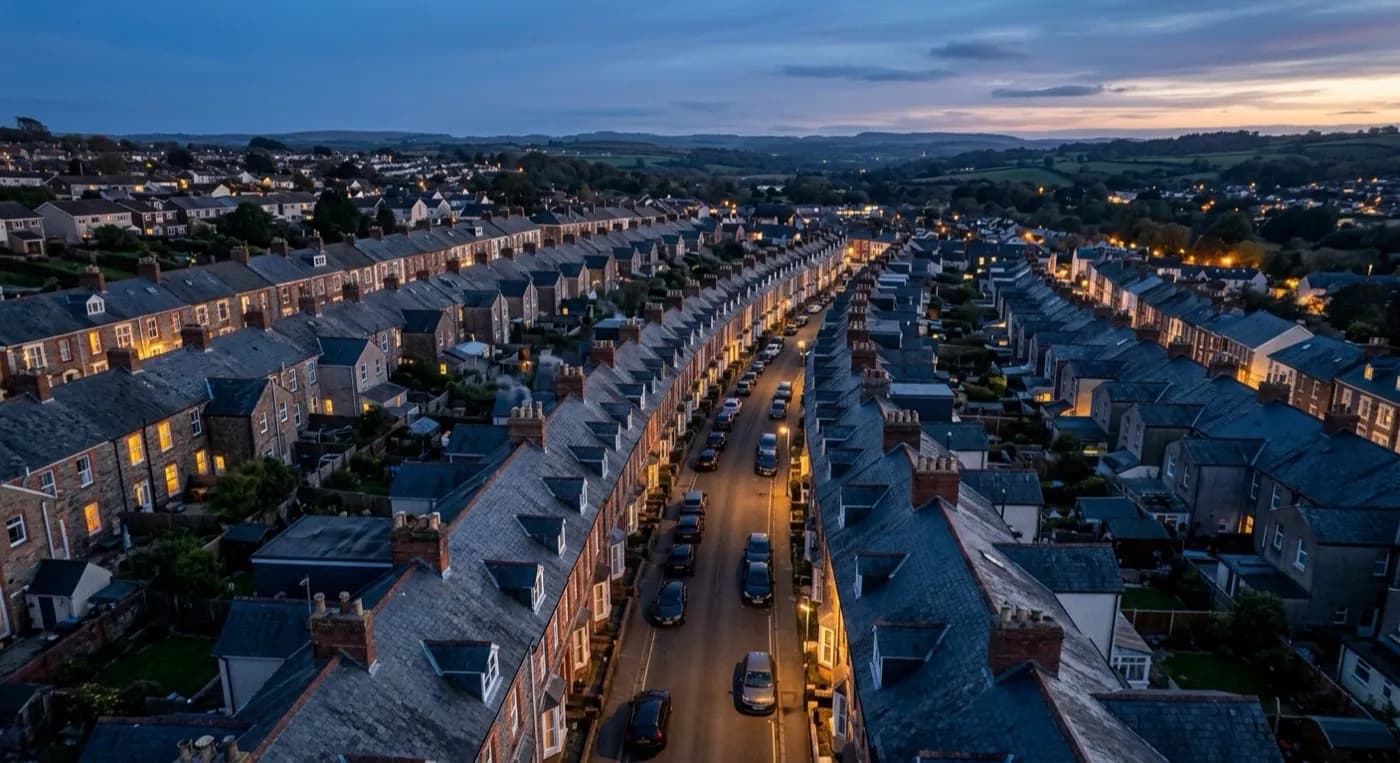
Exeter carries an unusual spread of construction ages within a couple of miles. The Georgian streets around Southernhay and the Victorian terraces of Heavitree, St Thomas and Newtown are solid wall, brick or stone through the full thickness with no cavity at all, so a thermal camera reading a cold patch there is reading heat moving straight through the masonry, not escaping through a gap that can simply be topped up.
The post-war ring at Wonford, Whipton and Beacon Heath is a different building altogether: cavity wall as standard, built to whatever insulation expectation existed at the time, which for most of that stock means a narrow, often unfilled cavity. Push further out to the newer development towards Pinhoe and Cranbrook and the construction changes again to modern insulated cavity or timber frame, where a thermal reading is usually checking for a workmanship gap rather than an absent material.
Where the heat actually leaves
On the solid wall stock the pattern to look for is thermal bridging at party walls, window reveals and the junction between a main roof and a rear addition, because those are the points where the wall thickness or the roof structure changes and heat finds the shortest path out. The valley air here holds damp, and rainfall above the England average means a solid wall that is also holding moisture loses heat faster than the same wall dry, which is one reason a survey timed after a spell of wet weather needs to be read carefully rather than taken at face value.
On the cavity-built ring, the more common finding is a loft that has never been topped up to current depth, or a cavity fill that has slumped and left a gap along the top of the wall under the eaves, both of which show as a clear, sharply edged warm band rather than the more diffuse bridging pattern typical of the older stock.
Flying it, and the airspace to plan around
A dawn flight over the tight Heavitree and St Thomas terraces works well precisely because the city holds its damp valley air overnight, giving a clean temperature difference by first light. In the conservation areas around the cathedral and the Quayside it also means nothing touches a listed elevation, which matters when the wall itself is the thing being read.
Exeter Airport sits east of the city with a flight restriction zone around it, so addresses towards Clyst Honiton, Sowton and the Airport Business Park are checked properly before a date is set rather than discovered on the morning of the flight.
Behind the survey
What Exeter clients are actually buying
CAA registered
Operator ID and Flyer ID held, plus the A2 Certificate of Competency. Every flight, including the early morning and after-dark ones this survey often needs, is planned to the rules that apply to the site.
Radiometric thermal camera
A DJI Mavic 2 Enterprise Advanced carrying a 640 by 512 radiometric sensor. Radiometric means every pixel is an actual temperature reading, not just a colour, which is what makes a genuine comparison across a roof or a wall possible.
100 megapixel visual pass
A DJI Mavic 4 Pro with a Hasselblad camera flies alongside the thermal camera on every job, so a warm or cool patch on the thermal image can be matched back to the actual roof feature or wall detail underneath it.
Insured with Coverdrone
Full commercial cover for the operation. Certificates go to managing agents, landlords and insurers as a matter of course, without anyone having to chase for them.
Nearby
Also covered around Exeter
- TopshamThermal surveys in Topsham, where listed merchant houses with no cavity to fill sit against an estuary that keeps every solid wall permanently a little damp.
- ExmouthThermal surveys in Exmouth, where Regency and Victorian solid-wall villas share the town with seafront flat-roofed apartment blocks that lose heat in a completely different way.
- CreditonThermal surveys in Crediton, where cob and thatch cottages in the lanes and barn conversions across the farmland edge carry some of the most varied insulation histories here.
- CullomptonThermal surveys in Cullompton, where cob and thatch survive in the old lanes behind a Georgian Fore Street, outnumbered by a large and continuing spread of modern estate housing.
- Newton AbbotThermal surveys in Newton Abbot, where large numbers of Victorian railway-era terraces sit beside extensive post-war estates on the damp, low-lying floodplain of the Teign.
See what it can and cannot see
Book a thermal survey in Exeter
Send the address and what is worrying you. Sam Hembury will come back with a fixed price and the next slot that suits the weather.