Devon · EX16
Thermal imaging survey in Tiverton
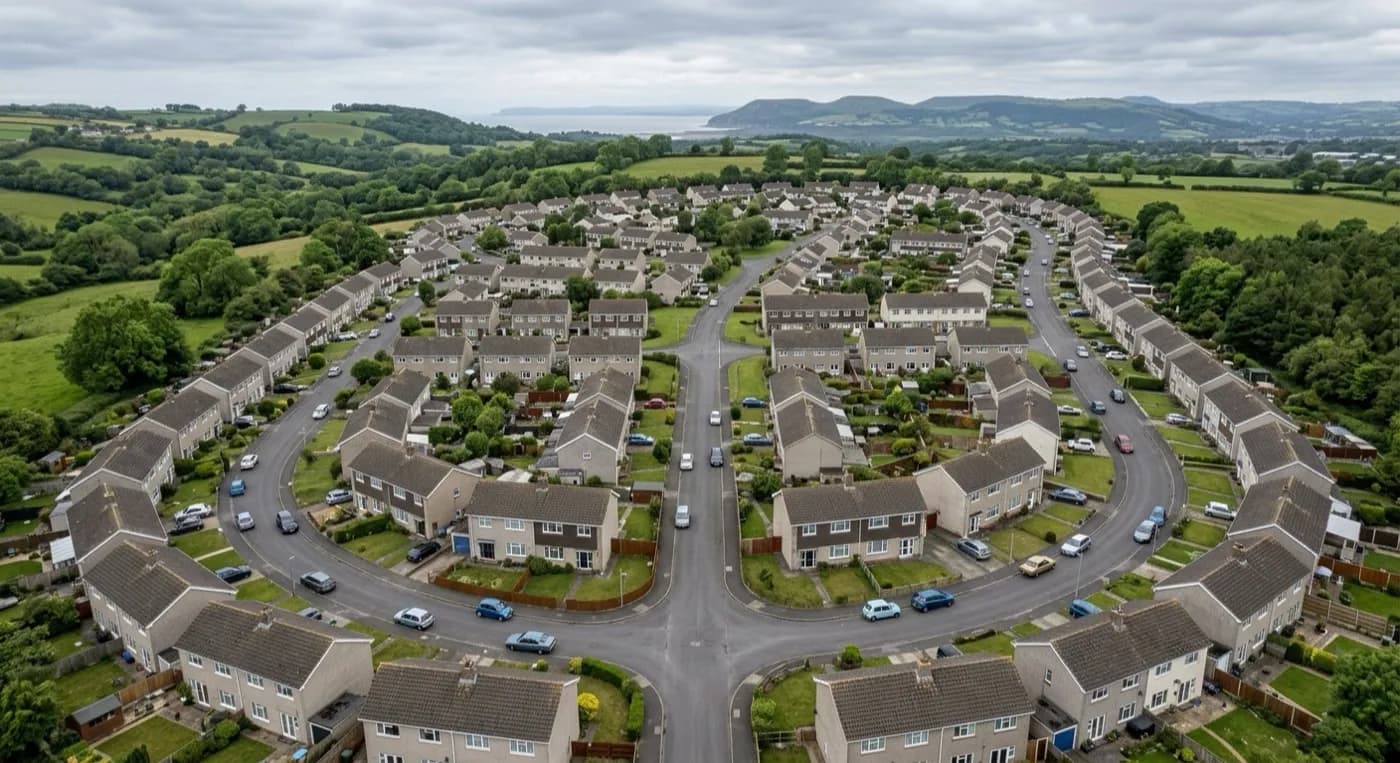
Thermal surveys in Tiverton, where Victorian mill workers' terraces on steep streets sit below extensive post-war and large modern estates on the eastern edge of the town.
Mill terraces and a lot of later estate housing
Tiverton's Victorian mill-era terraces are solid wall, built quickly and cheaply for a working population, often with thinner walls and less generous roof detailing than the grander Georgian stock found in some of the other market towns on this list, which can mean thermal bridging shows up more readily and more widely across a whole street rather than as an isolated finding on one house. The medieval and Georgian centre is a smaller, older core again, while the extensive post-war estates and the large modern development on the eastern edge bring in the full cavity-era range, the newest of it built to a meaningfully better standard than the 1960s and 70s stock nearer the centre.
Because the mill terraces were built in large, repeated runs, a finding on one property here is often actually representative of its immediate neighbours, which is useful context for a landlord or a street association weighing up whether a single survey is enough or several are needed.
A steep, wet valley
The town is built where the Lowman joins the Exe on steep-sided ground, with the centre low and residential streets climbing sharply north and west. The Exe valley here is notably wet, well above the Devon average, and the steep sites mean many roofs and upper walls sit above the general roofline where wind loading and driving rain are both higher than the sheltered valley floor below.
For the mill terraces specifically, that combination of thin original walls and a actually wet local climate means a solid wall here is doing more thermal work, and losing more heat while wet, than the same style of building would in a drier inland town.
Flying steep streets and a spread estate edge
The steep streets around the mill terraces are flown from a stand-off distance that respects the gradient and the close-packed roofline, and a dawn flight after a cold, clear night is the usual choice given how wet this valley runs generally.
On the eastern estate edge, coverage is more straightforward, wider streets and more consistent modern construction, and a survey there is closer in character to any large South West new-build development.
Properties near Tiverton Castle and the Grand Western Canal sit among the oldest stock in the town, solid wall with the canal's damp air adding a further source of persistent moisture to walls that are already working hard in this valley's above-average rainfall. Closer to Blundell's School and Knightshayes Court, the housing shifts to larger Victorian and Edwardian villas on more generous plots, still solid wall but with a different roof geometry and window arrangement to the tighter mill terraces nearer the centre, and a survey there is planned accordingly rather than assumed to match the terraced stock.
Behind the survey
What Tiverton clients are actually buying
CAA registered
Operator ID and Flyer ID held, plus the A2 Certificate of Competency. Every flight, including the early morning and after-dark ones this survey often needs, is planned to the rules that apply to the site.
Radiometric thermal camera
A DJI Mavic 2 Enterprise Advanced carrying a 640 by 512 radiometric sensor. Radiometric means every pixel is an actual temperature reading, not just a colour, which is what makes a genuine comparison across a roof or a wall possible.
100 megapixel visual pass
A DJI Mavic 4 Pro with a Hasselblad camera flies alongside the thermal camera on every job, so a warm or cool patch on the thermal image can be matched back to the actual roof feature or wall detail underneath it.
Insured with Coverdrone
Full commercial cover for the operation. Certificates go to managing agents, landlords and insurers as a matter of course, without anyone having to chase for them.
Nearby
Also covered around Tiverton
- CullomptonThermal surveys in Cullompton, where cob and thatch survive in the old lanes behind a Georgian Fore Street, outnumbered by a large and continuing spread of modern estate housing.
- CreditonThermal surveys in Crediton, where cob and thatch cottages in the lanes and barn conversions across the farmland edge carry some of the most varied insulation histories here.
- ExeterThermal surveys across Exeter, where solid Georgian and Victorian walls in the old quarters and mass cavity-built estates on the outer ring lose heat in almost opposite ways.
- WellingtonThermal surveys in Wellington, where a Georgian and Victorian mill town with terraced mill workers' housing sits below an escarpment that accelerates wind over the town.
See what it can and cannot see
Book a thermal survey in Tiverton
Send the address and what is worrying you. Sam Hembury will come back with a fixed price and the next slot that suits the weather.